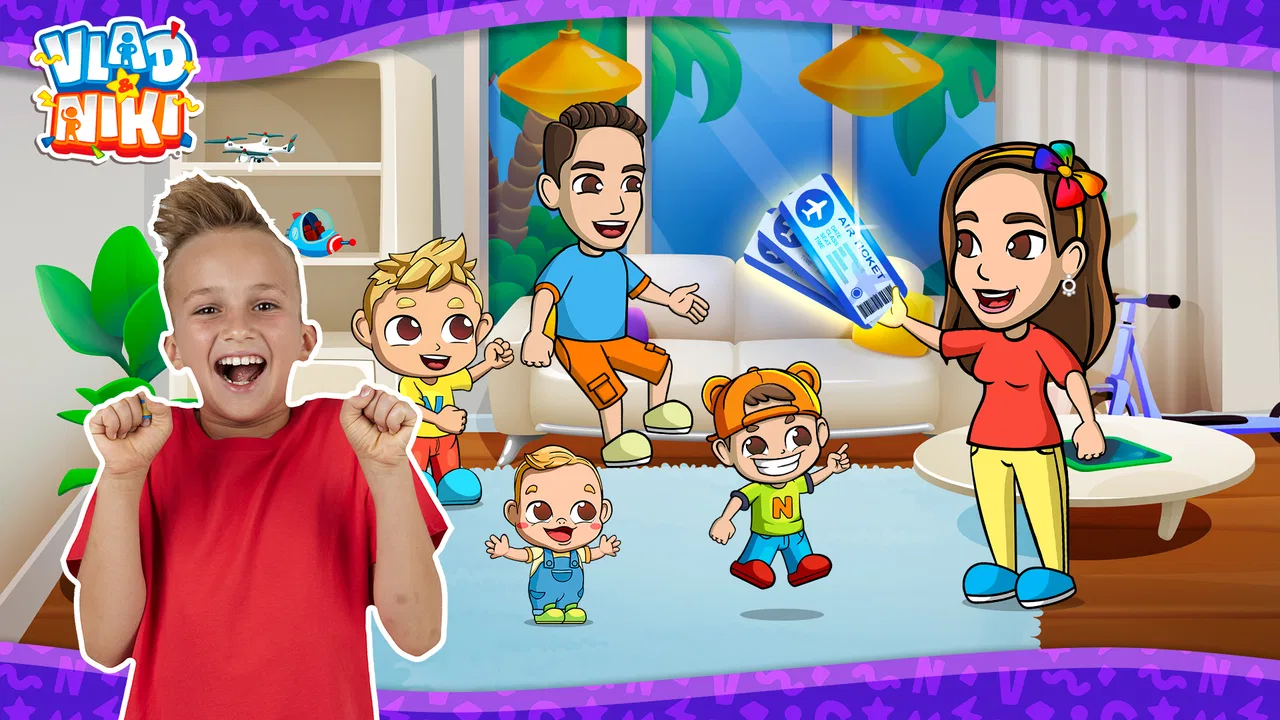
Vlad and Niki - World Travel
- 4.8
- Rating
- 1.00M
- Installs
- Free
- Price

 Analysis by App-foxy
My first impression of Vlad and Niki - World Travel is that it aims to make learning feel like a small trip rather than a lesson at a desk. It is a free educational game from Hippo Kids Games, built around Vlad and Niki and their journey through different parts of the world. The idea is simple, but the presentation matters here: the game uses familiar characters, bright scenes, and short activities to give children a reason to keep exploring.
I approached it as something a child might play in short bursts, perhaps while waiting at a restaurant, relaxing after school, or sitting beside a parent during a quiet afternoon. That is where it makes the most sense. It is not trying to replace a structured geography course, and I would not treat it as a deep academic tool. Instead, it works as a friendly introduction to the idea that places around the world have different visual identities, sounds, objects, and ways of inviting curiosity.
The game has an Everyone content rating, which fits its gentle educational direction. It is available without an upfront purchase, although optional in-app items range from around two dollars to ten dollars each. That makes it easy to try, but I would still suggest that an adult look at the purchase settings before handing over a device. The free entry is useful for deciding whether the style suits a particular child.
You May Also Like

 Blood Strike: 2.5 Anniversary
Blood Strike’s Loadouts Turn Every Drop Into a Tactical Gamble
A close look at Blood Strike’s custom loadouts: how fast access to signature weapons reshapes its battle royale rhythm, rewards preparation, and narrows the gap between fights.

 Pandora - Music & Podcasts
Pandora’s Music Is Easy to Start, but Harder to Recover
Pandora’s strength is its low-effort path from a seed to a station. Its weak spot is how much confidence it asks you to place in connection, setup, and quiet recovery.

 8 Ball Pool
 Is Built on Rivalries, Rematches, and Routine
A close look at the rivalries, rematches, shared routines, and unanswered safety questions that turn a quick pool match into a persistent mobile community.

 Samsung Music
’s Quiet Strength Is Playing What You Already Own
Its reach comes less from spectacle than from dependable access to a personal library. That simplicity is both the app’s strongest retention engine and its ceiling.

 AccuWeather: Weather Radar
AccuWeather Review: A Quick, Clear Forecast for Everyday Decisions
For everyday plans, the best forecast is the one you can understand quickly. AccuWeather makes rain timing, radar, and local conditions easy to act on, with a few trade-offs.

 Hill Climb Racing
Why Hill Climb Racing Still Turns Crashes Into One More Run
A tiny car, a bumpy hill and one more upgrade: Hill Climb Racing keeps resurfacing because its simple chaos makes every near-miss feel personal.
More From Our News Desk



A bright travel theme that speaks through pictures
The strongest part of the experience is its visual language. Rather than presenting travel as a list of facts, the game frames it as a sequence of playful discoveries. Vlad and Niki provide a recognizable center, while the changing destinations give the child a reason to look around and notice differences. The art direction is clearly aimed at keeping scenes approachable instead of making them feel like a textbook illustration.
That choice is important for younger players. A child who might ignore a page about geography can respond to a character-led scene with colorful objects and a clear visual goal. The setting becomes part of the invitation to play. I found that the world feels most successful when the background is not merely decoration but helps establish where the activity is taking place.
The presentation also gives the game a coherent mood. The characters, travel theme, and cheerful visual treatment belong together, so the experience does not feel like unrelated mini-games placed under a travel label. Even when the learning is light, the setting keeps the child oriented. The world is presented as something welcoming and discoverable, not intimidating.
Parents should keep expectations realistic, though. A game like this can encourage interest in countries, landmarks, and cultural differences, but it should be treated as a starting point for conversation rather than a complete explanation of the world. After a session, I would ask the child what they noticed, which place they liked, or what they would want to see next. That simple follow-up turns passive screen time into a more meaningful activity.
One useful habit is to let the child describe the scene before offering answers. Ask them to identify colors, clothing, buildings, animals, or objects they recognize. This makes the visual design do more educational work. The game supplies the prompt, while the adult helps the child connect the image with language and memory.
Why the setting works for short play sessions
The travel structure gives children a natural sense of movement. They are not simply repeating the same lesson in a blank interface; they are following characters through a themed adventure. That framing can help with motivation, especially for children who need a story or destination to make an activity feel worthwhile.
It is also a good fit for uneven attention spans. A child does not need to commit to a long sitting to enjoy the concept. Short sessions make it easier to stop before frustration appears, which is often better than pushing through until the game becomes associated with pressure. I would use it as a small activity between other parts of the day, not as an app that stays open indefinitely.
There is a trade-off in this approach. A gentle travel adventure may be more inviting than a serious learning platform, but it is unlikely to satisfy an older child looking for detailed facts, demanding puzzles, or measurable academic progress. For that audience, a dedicated geography app, atlas, or guided lesson would be the stronger choice. This game is at its best when curiosity and recognition matter more than depth.
Sound, pacing, and the feeling of moving forward
The sound design supports the same friendly mood as the artwork. In a children’s game, audio has to do several jobs at once: make actions understandable, keep the pace lively, and avoid becoming tiring for the adult sitting nearby. Here, the overall tone is designed to make the journey feel active without turning it into a stressful race.
I see the pacing as one of the game’s practical strengths. Travel is presented as a sequence of manageable moments, so the child can focus on what is happening now instead of worrying about a complicated system. That helps younger players understand the basic rhythm of play: observe the scene, respond to the activity, receive feedback, and continue the adventure.
This rhythm is also why the game can work well in a shared setting. A parent can watch for a few minutes and understand what the child is doing without needing to learn a complicated control scheme. If the child gets stuck, an adult can guide them through the visual clues rather than taking over an elaborate set of controls.
There is a quiet advantage to this kind of pacing: it leaves room for conversation. When a game moves too quickly, children may tap through everything without noticing the setting. With a calmer travel structure, I can pause and ask what a character is doing or why a scene looks different. That turns the game’s rhythm into a useful teaching opportunity.
At the same time, children who prefer fast action may find the experience less exciting. This is not the right choice for someone expecting arcade speed, competitive scoring, or constant challenge. Its mood is exploratory and reassuring. The lack of pressure is a benefit for younger players, but it can feel gentle to the point of simplicity for experienced gamers.
How I would use it during an ordinary day
Imagine a child waiting for an appointment with a parent. The adult wants something more constructive than an endless stream of short videos, but there is not enough time for a full lesson. This is the kind of situation where the game makes sense. A short session can introduce a travel setting, keep the child occupied, and create an easy topic to discuss afterward.
I would set a clear stopping point before starting. For example, the child could explore for a while and then explain one thing they remember. That small routine prevents the game from becoming an automatic distraction and encourages active recall. It also helps a parent judge whether the child is genuinely interested or simply tapping through the scenes.
Another useful approach is to play together the first time. Watch how the child responds to the visuals and sound, then decide whether independent play is appropriate. Some children will understand the activities immediately, while others will benefit from a little guidance. The game’s approachable design makes co-play easy, but it does not remove the value of adult involvement.
Mechanics that serve the educational mood
The mechanics are most effective when they stay connected to the travel idea. The game does not need an elaborate progression system to make its point. Its value comes from allowing the child to interact with a world that feels organized around discovery. The characters and destinations provide context, while the activities give the child something concrete to do.
That balance is important. If the game were only a slideshow of places, it would be easy to lose attention. If it were only a collection of unrelated tasks, the world-travel theme would feel superficial. The better moments come when the setting and the interaction reinforce each other, so the child feels that the activity belongs to the place being explored.
I also appreciate that the game’s educational purpose is not presented as a formal test. A child can approach it with curiosity rather than fear of getting an answer wrong. That makes it more suitable for early exploration, especially for children who become discouraged by conventional quizzes or progress bars.
The limitation is that light interaction can only go so far. Parents looking for detailed explanations, written exercises, or a clear curriculum should use another resource alongside it. A child may remember a visual impression without understanding the broader context behind it. That is not a flaw in a casual educational game, but it is a reason to treat the app as one part of learning rather than the whole experience.
Compared with a standard children’s geography video, this game has the advantage of asking the child to participate. The child is not only watching a presenter move from one topic to another; they are engaging with the scenes and characters. Compared with a serious educational platform, however, it offers less structure and less evidence of progression. I would choose this game for motivation and first exposure, then move to books, maps, or more focused learning tools when the child starts asking detailed questions.
Compared with a typical puzzle game, its challenge is less important than its context. The goal is not to master difficult patterns or beat a personal best. That makes it more accessible, but it also means that replay value may depend heavily on the child’s fondness for Vlad and Niki and the pleasure of revisiting the travel scenes.
Practical considerations before installing
The game is free to start, which lowers the barrier for families who want to test it. Optional purchases are available, priced from around two dollars to ten dollars per item. I would not assume that every child needs them. First, see whether the free experience holds attention and whether the educational tone fits the child. If the game becomes part of a regular routine, an adult can then decide whether any optional content is worthwhile.
It runs on devices using Android 7.0 or later. That is useful to check before planning a family activity around it, especially if the child uses an older phone or tablet. The current version is 1.0.6, so I would keep the app updated through the normal device store when updates are available, since children’s apps can benefit from ongoing fixes and refinements.
Its popularity also suggests that it has found an audience: the game has passed half a million installs and holds an average rating of 4.8 from roughly two thousand ratings. I see that as encouraging, but not as a substitute for judging the fit for your own child. A highly rated game can still be too gentle for one child, too colorful for another, or too simple for an older learner.
Hippo Kids Games is a developer known for child-focused experiences, and that focus is evident in the way this game prioritizes recognizable characters and approachable presentation. Still, parents should remain involved with any app aimed at children. Check the device’s purchase controls, consider playing the opening session together, and use the travel theme as a prompt for real-world discussion rather than relying on the screen alone.
Who will enjoy the atmosphere, and who should skip it
I would recommend this game to families looking for a calm, character-led introduction to travel and world awareness. It suits children who respond to bright visuals, familiar personalities, and activities that do not demand advanced reading or complicated controls. It is especially useful when the goal is to replace completely passive entertainment with something that at least invites observation and conversation.
I would be more cautious about recommending it to older children who already know a lot about geography. They may want maps, country facts, quizzes, or progressively harder challenges, and this game’s welcoming simplicity may not provide enough substance. It is also not the best match for a child who wants competitive play or fast action. In those cases, a more focused educational game or a traditional geography resource would offer better long-term value.
The atmosphere is the main reason to choose it. The art, characters, travel setting, and sound work toward the same feeling: a safe, cheerful journey that encourages a child to look around. The mechanics support that mood instead of fighting it. I would not describe the experience as demanding, but I would describe it as coherent, and coherence matters when a game is aimed at very young players.
My most useful tip is to treat each session as a conversation starter. Ask the child to remember a place, describe something in the scene, or draw a picture inspired by the journey. A second tip is to avoid using it only as a reward or distraction; introducing it as a shared discovery makes the educational purpose clearer. A third is to stop while the child is still interested, because leaving room for the next session can preserve the sense of adventure.
There is also a practical trade-off between convenience and depth. The game is easy to begin, visually inviting, and suitable for short play, but it cannot provide the same understanding as a parent-led discussion, a real map, or a carefully designed course. I would pair it with those resources if the child shows genuine interest in the places being visited. The app can open the door; it should not be expected to furnish the entire room.
Overall, I found the experience most convincing as a mood-driven educational adventure. It makes travel feel friendly, gives children recognizable guides, and uses its presentation to keep learning approachable. The free starting point makes it easy to explore, while the optional purchases mean adults should manage the device rather than leave decisions entirely to a child.
My recommendation is simple: choose it when you want a gentle way to spark curiosity about the wider world, especially during short shared sessions. Skip it if you need deep geography lessons, demanding gameplay, or a clearly structured academic program. For the right age and situation, the combination of art direction, sound, setting, and relaxed pacing creates a pleasant playable mood that supports its educational purpose without pretending to be more comprehensive than it is.
FAQs for Vlad and Niki - World Travel
01What is Vlad and Niki - World Travel about?
Vlad and Niki - World Travel is an engaging adventure game designed for young audiences. It features the popular YouTube stars Vlad and Niki as they embark on exciting global journeys. Players can explore various countries, solve puzzles, and complete missions that promote learning about different cultures and geography.
02Is Vlad and Niki - World Travel suitable for all ages?
Yes, Vlad and Niki - World Travel is designed with young children in mind, but it can be enjoyed by players of all ages. The content is family-friendly, featuring colorful graphics and simple gameplay mechanics that make it accessible and entertaining for both children and their parents.
03Are there in-app purchases in Vlad and Niki - World Travel?
Yes, the game includes in-app purchases. While the basic version is free, there are options to buy additional features, such as new levels or special items. Parents should be aware and monitor or restrict in-app purchases to prevent unintended spending by children.
04What devices is Vlad and Niki - World Travel compatible with?
Vlad and Niki - World Travel is available on both Android and iOS platforms. It supports a wide range of devices, but it's recommended to check the specific compatibility with your device's operating system version to ensure smooth gameplay and avoid any technical issues.
05Does Vlad and Niki - World Travel require an internet connection?
The game can be played both online and offline. However, certain features, such as updates or in-app purchases, may require an internet connection. Playing offline is a great option for uninterrupted gameplay during travel or in areas with limited connectivity.
Pros
- Engaging and colorful graphics.
- Variety of mini-games available.
- Educational and entertaining content.
- Intuitive controls for kids.
- Frequent updates with new content.
Cons
- In-app purchases can be costly.
- Requires internet for some features.
- Ads may interrupt gameplay.
- Limited free content available.
- Some games may be repetitive.

Vlad and Niki - World Travel
Gallery